What I've Learned After a Decade in SEO About Where Search Is Headed
By the Pixeloft Team | 10+ Years in Search Marketing | www.pixeloft.in
I've been doing SEO for over ten years now. I've watched Google roll out Panda, Penguin, Hummingbird, BERT, and a dozen core updates that made agencies panic overnight. I've seen "SEO is dead" declared more times than I can count. Every single time, SEO didn't die — it adapted. And it's adapting again right now, faster than I've ever seen.
This time the shift isn't a ranking algorithm tweak. It's a change in how people search altogether. Google is turning into an AI Search engine. ChatGPT and Perplexity are becoming search engines in their own right. And the old playbook of "rank in the top 10 and wait for clicks" is no longer enough on its own.
Here's what a decade in this industry has taught me about the shift from traditional search to AI search — and what it actually means for your business.
Is SEO Really Dying?
No. SEO isn't dying — it's expanding. The fundamentals of relevance, authority, and trust still decide who wins. What's changed is the format of the answer: search engines now synthesize direct responses instead of only listing links, so brands need to optimize for being cited, not just ranked.
I say this every time a client asks me if SEO is worth the investment anymore: the goal has never changed. Show up when someone needs what you offer. What's changed is the mechanism search engines use to decide who deserves that spot — and the format they use to deliver the answer.
How Is Traditional Search Different From AI Search?
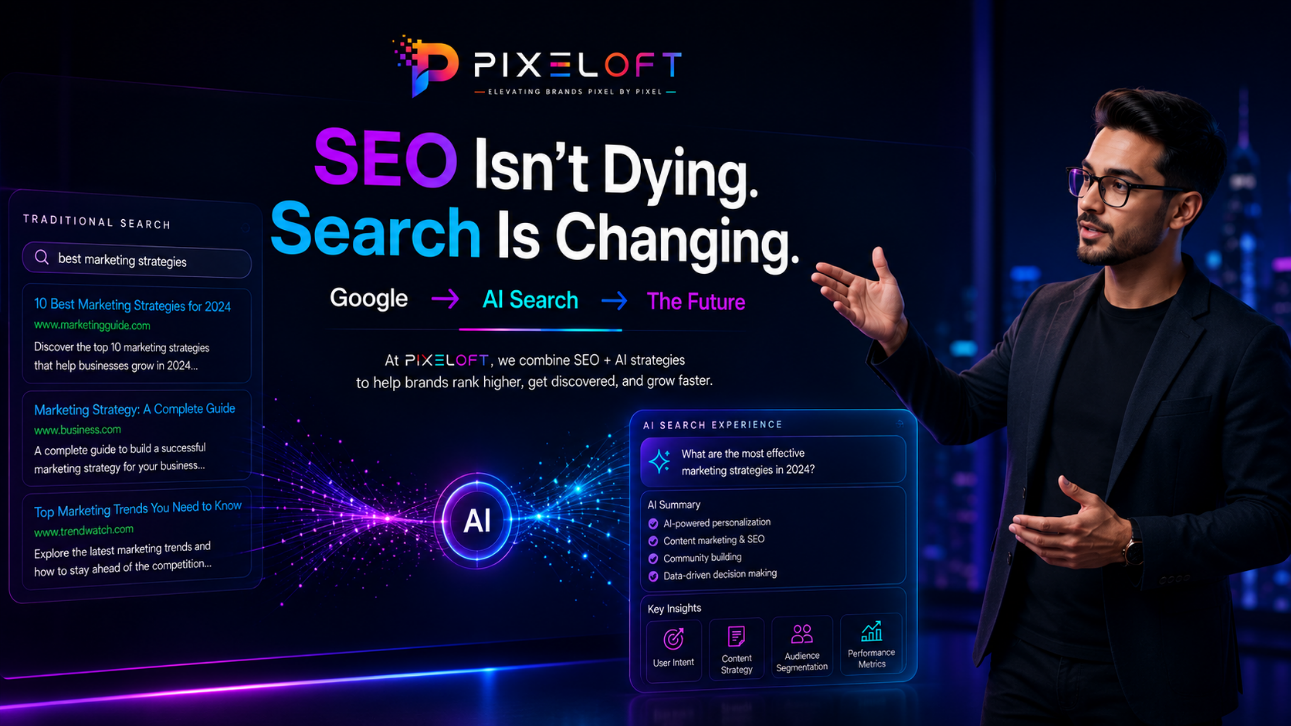
Traditional search: the ten blue links
For most of my career, search meant this: a user typed "best marketing strategies," and Google handed back a ranked list of pages — a title, a URL, a snippet. The user clicked through two or three results, compared them, and pieced together their own answer. Winning meant earning that click through keyword targeting, backlinks, and solid on-page SEO.
That model isn't gone. It still drives a huge share of traffic, and the fundamentals behind it — technical SEO, content quality, link authority — are still the foundation everything else is built on.
AI search: the direct-answer experience
AI search works differently, and this is the part I think most businesses still underestimate. Ask an AI search engine the same question — "What are the most effective marketing strategies in 2026?" — and instead of ten links, you get one synthesized answer, built from multiple sources, often including:
A direct, conversational answer summarizing the topic up front
Structured highlights — things like AI-powered personalization, content marketing & SEO, community building, data-driven decision making
Related insight modules — user intent, content strategy, audience segmentation, performance metrics
Knowledge connections — how concepts like AI personalization, SEO & content, analytics, and growth relate to one another
In ten years, I've never seen a shift this significant in how the click actually happens — because increasingly, it doesn't. The user gets their answer inside the AI interface itself. If your content isn't the source behind that answer, you're invisible, even if you'd have ranked #1 the old way.
Why Should Businesses Care About This Shift?
Because visibility is being redefined. Ranking on page one used to guarantee traffic. Now, being the source an AI engine cites — its facts, its structure, its data — often matters more than the position of your link on a results page.
I've had this conversation with dozens of business owners over the years, and the instinct is always the same: "We rank well, so we're fine." That instinct made sense five years ago. It's riskier today. If an AI engine answers the question before the user ever reaches a search results page, your ranking never gets the chance to matter — unless your content was the one the AI pulled from.
What Actually Works: SEO + AI Strategy Combined
This is the approach we use with clients at Pixeloft, and honestly, it's the same discipline I've leaned on for years — just pointed at a wider target now. Four things matter most.
1. Map real user intent, not just keywords
AI systems reward content that answers the actual underlying question a person has, not content built around keyword density. If you're still writing for search terms instead of for the person asking the question, this is the first habit to break.
2. Structure content so it can be understood and cited
Clear headings, direct answers near the top, well-organized facts, and credible data — this is what makes content easy for an AI system to summarize and, ideally, cite by name. Vague, meandering content simply doesn't get pulled into AI answers, no matter how well it once ranked.
3. Segment your audience by how they actually search
Different audiences phrase questions differently and search at different stages of intent — awareness, comparison, decision. Content built for one generic audience wastes the specificity that both traditional SEO and AI synthesis reward.
4. Track visibility beyond the rankings report
Ranking position alone doesn't tell the full story anymore. We track presence across AI Overviews and answer engines alongside traditional SERP rankings, because that's the only way to see the whole picture of where your brand actually shows up.
The Knowledge Connections Behind a Modern Strategy
One thing I've come to believe firmly after ten years in this field: isolated tactics don't work anymore. A modern strategy has to connect its parts the same way AI systems connect concepts:
AI Personalization — tailoring content and experience using real data, not guesswork
SEO & Content — building authoritative, well-structured content that both ranks and gets cited
Analytics — measuring what's actually happening across search and AI channels, not just clicks
Growth — turning visibility, wherever it happens, into real business outcomes
My Bottom Line After a Decade in This Industry
Every few years, someone declares SEO dead. Every time, they're wrong — because they're mistaking a change in format for an end of relevance. Search isn't disappearing. It's becoming more conversational, more synthesized, and more demanding of genuinely good, well-structured content.
The brands that will struggle are the ones still optimizing purely for keyword density and backlink counts. The brands that will win are the ones treating SEO and AI search as one connected strategy, not two separate battles.
Want Help Getting There?
At Pixeloft, we combine SEO fundamentals with AI-ready content strategy to help brands rank higher, get discovered, and grow faster — in traditional search and in the AI-driven search experiences shaping what comes next. Visit www.pixeloft.in to talk to our team.