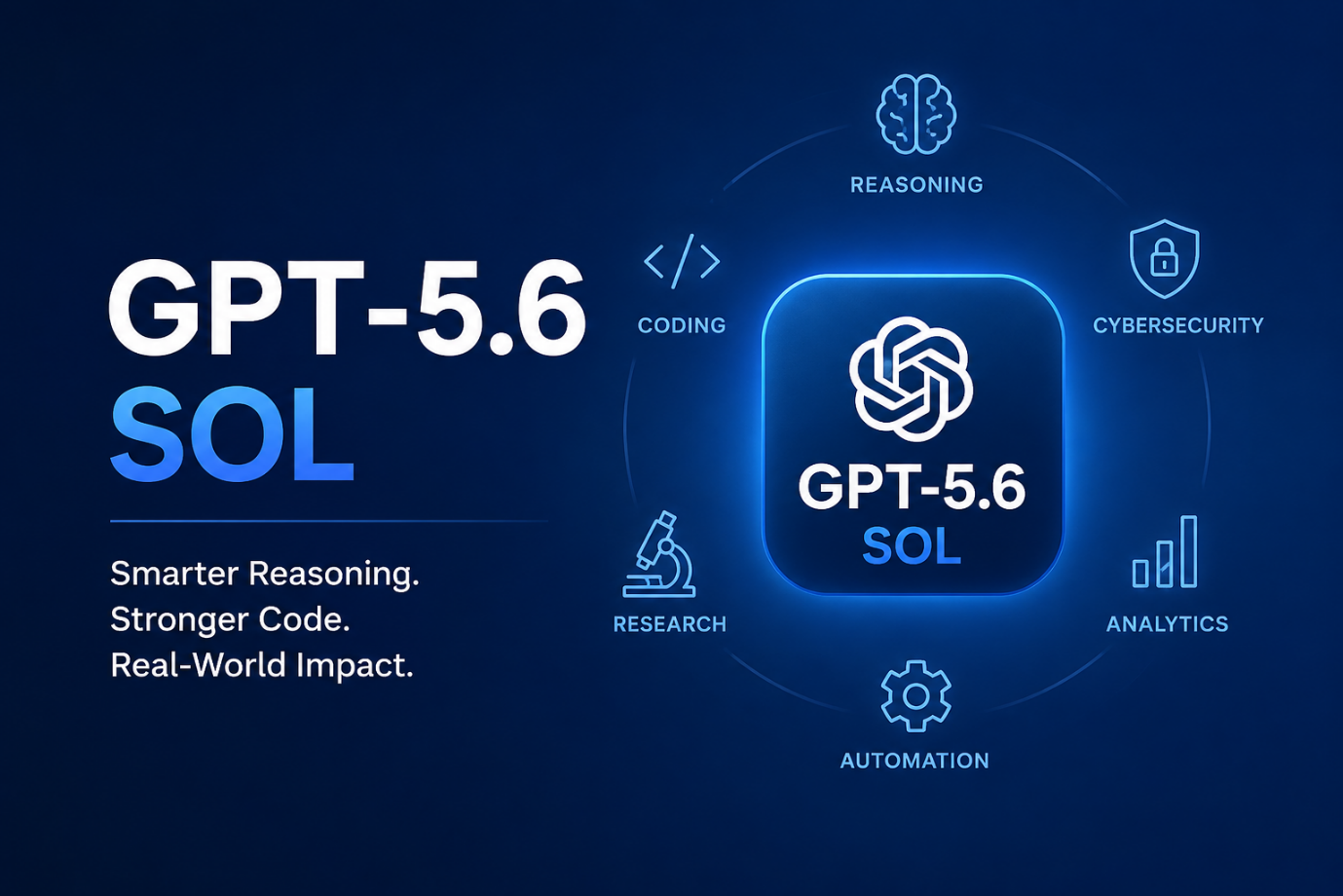
Artificial intelligence is rapidly progressing from a simple question-and-answer tool into a capable digital partner that can support complex, multi-step work. OpenAI’s GPT-5.6 Sol represents an important step in this transformation.
GPT-5.6 Sol is the flagship model in OpenAI’s GPT-5.6 family. It is designed for demanding professional tasks that require deeper reasoning, advanced coding ability, long-term planning and reliable execution. The GPT-5.6 family also includes Terra, which balances intelligence and cost, and Luna, which is optimized for speed and high-volume workloads.
What Is GPT-5.6 Sol?
GPT-5.6 Sol is OpenAI’s most capable model in the GPT-5.6 series. It is built to handle complex assignments across areas such as software development, scientific research, cybersecurity, business analysis and knowledge work.
Unlike traditional AI systems that often perform best with short and highly specific instructions, GPT-5.6 Sol is designed to work toward a broader outcome. It can interpret ambiguity, plan multiple steps, use available tools and adjust its approach as the work progresses.
The name Sol, meaning “sun,” reflects its position as the leading model within the GPT-5.6 family.
Key Capabilities of GPT-5.6 Sol
1. Advanced Reasoning
GPT-5.6 Sol is designed to analyse complicated problems more deeply before producing an answer. This makes it suitable for tasks that involve several connected decisions, incomplete information or competing priorities.
Businesses can use it to evaluate reports, identify operational issues, compare strategies and develop structured recommendations.
2. Stronger Coding Performance
Software development is one of the major focus areas of GPT-5.6 Sol. The model can assist developers with writing code, identifying bugs, understanding large codebases, planning technical architecture and completing multi-stage development tasks.
It is particularly valuable for projects where the AI needs to work across several files, follow technical requirements and maintain context throughout a longer workflow. OpenAI describes Sol as its flagship choice for complex reasoning and coding.
3. Long-Horizon Agentic Work
One of the most significant developments in GPT-5.6 Sol is its ability to support long-horizon agentic workflows.
An agentic workflow involves more than generating a single response. The AI may need to:
Understand the final objective.
Divide the work into smaller tasks.
Use tools or external systems.
Review intermediate results.
Correct mistakes.
Continue until the required outcome is completed.
This could make GPT-5.6 Sol useful for research projects, business reporting, software testing, data analysis and workflow automation.
4. Scientific and Technical Research
GPT-5.6 Sol offers stronger capabilities in scientific reasoning and technical problem-solving. Researchers may use it to review information, examine hypotheses, analyse experimental results and connect findings across multiple disciplines.
However, AI-generated scientific or technical work should still be reviewed by qualified professionals, particularly when it affects safety, health or critical infrastructure.
5. Cybersecurity Capabilities
GPT-5.6 Sol has advanced cybersecurity capabilities that may support defensive security work, vulnerability analysis and the protection of digital systems.
Because powerful cybersecurity models can also create risks, OpenAI says the GPT-5.6 release includes stronger safeguards for high-risk requests, sensitive cyber activity and repeated attempts at misuse.
6. Improved Efficiency
Greater intelligence is valuable only when it can be used practically. OpenAI states that GPT-5.6 Sol improves performance while using fewer tokens for certain workloads, potentially providing stronger results for the same spending or comparable outcomes at a lower total cost.
The actual efficiency for an organisation will depend on the type of task, prompt design, tool usage and the number of times human review is required.
GPT-5.6 Sol, Terra and Luna
The GPT-5.6 family is structured around different business requirements.
GPT-5.6 Sol is the flagship model for frontier reasoning, advanced coding and complex professional work.
GPT-5.6 Terra is intended for users who need strong intelligence while maintaining a better balance between performance and cost.
GPT-5.6 Luna is designed for faster, cost-sensitive and high-volume workloads.
This model family allows organisations to select different levels of intelligence for different tasks instead of using the most powerful model for every request.
For example, Sol may be used for strategic planning or complex software development, while Luna may be better suited for repetitive content classification or large-scale customer-support workflows.
How Businesses Can Use GPT-5.6 Sol
GPT-5.6 Sol may support organisations across several departments.
Marketing and Sales
Marketing teams can use it to develop campaign strategies, analyse customer feedback, create personalised communication and generate content for different customer segments.
Sales teams may use it to summarise lead information, prepare follow-up messages, identify buying signals and create structured sales reports.
Customer Service
GPT-5.6 Sol can help organisations build more capable support assistants that understand customer context, retrieve relevant information and guide users through complicated service processes.
Human escalation should remain available for complaints, financial decisions, safety-related matters and sensitive customer situations.
Software and IT
Development teams can use the model for coding, documentation, testing, debugging and technical research. IT teams may also use it to investigate system issues and support defensive cybersecurity operations.
Management and Operations
Business leaders can use GPT-5.6 Sol to analyse performance reports, compare operational data, identify risks and develop action plans.
It can also transform large amounts of unstructured information into clear summaries, recommendations and task lists.
Research and Knowledge Work
Consultants, analysts, researchers and legal or financial professionals may use GPT-5.6 Sol to organise information and accelerate initial analysis. Final outputs must still be verified against reliable sources and reviewed by the appropriate expert.
GPT-5.6 Sol in ChatGPT and the API
GPT-5.6 Sol is being introduced through ChatGPT for eligible plans, although availability may vary during the rollout. OpenAI’s help documentation advises that users who do not see Sol in the model picker may not have access on their account yet.
For developers, the GPT-5.6 models are available through OpenAI’s API platform. OpenAI states that the gpt-5.6 API alias routes requests to GPT-5.6 Sol. The release also introduces features including programmatic tool calling, persisted reasoning, prompt-caching controls and beta multi-agent orchestration.
These features may help developers create applications that can perform longer and more coordinated workflows.
Safety and Responsible Use
The capabilities of advanced AI models must be supported by strong safeguards.
OpenAI says GPT-5.6 has been released with its most robust safety stack to date. The company’s system card discusses protections relating to cybersecurity, biological and chemical risks, high-risk activities and potential misuse.
Organisations adopting GPT-5.6 Sol should also establish their own responsible-use practices. These should include:
Human review for important decisions.
Protection of customer and company data.
Clear restrictions on sensitive use cases.
Regular testing for inaccurate or biased outputs.
Monitoring of automated actions.
Defined accountability for AI-supported decisions.
AI should strengthen human decision-making rather than remove responsibility from the people and organisations using it.
What GPT-5.6 Sol Means for the Future of Work
GPT-5.6 Sol demonstrates how AI is moving beyond basic content generation. New-generation models are becoming more capable of planning work, coordinating tools, analysing complicated information and completing larger assignments.
This does not mean that every process should be fully automated. The greatest value may come from combining human judgement, experience and accountability with the speed and analytical power of AI.
Employees may spend less time on repetitive preparation and more time reviewing insights, making decisions, communicating with customers and solving higher-value problems.
Conclusion
GPT-5.6 Sol represents a major development in advanced artificial intelligence. With stronger reasoning, coding, scientific, cybersecurity and agentic capabilities, it is designed for some of the most demanding professional workloads.
Its real impact will depend on how responsibly and effectively organisations use it. Businesses that begin with clearly defined use cases, reliable data, human oversight and measurable objectives will be better positioned to benefit from this new generation of AI.
GPT-5.6 Sol is not simply another chatbot upgrade. It signals a future in which AI can become a more capable partner in research, technology, business operations and professional decision-making.