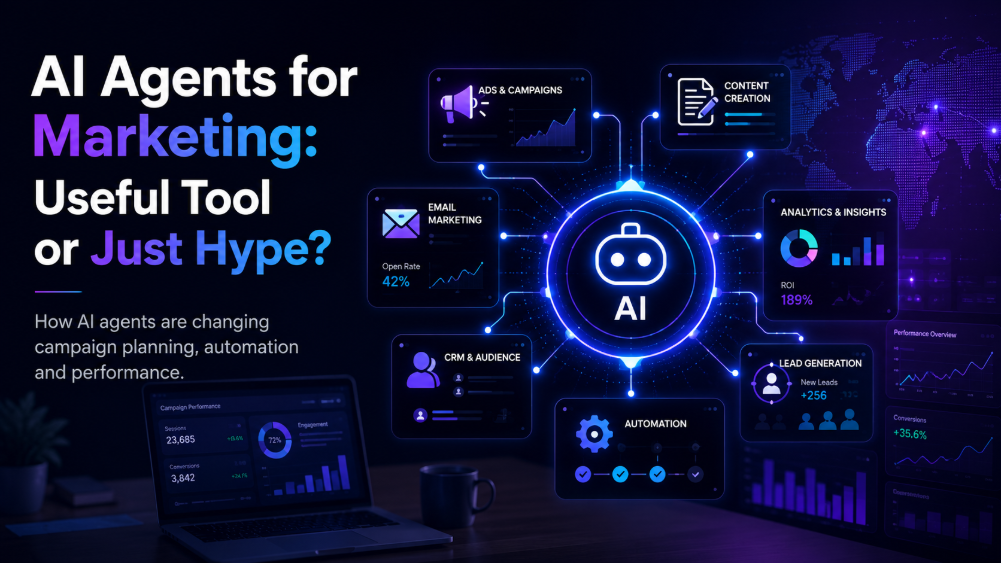
Useful Tool or Just Hype?
A practical guide to what AI marketing agents can do, where they create value, and where human judgement still matters.
Key takeaway: AI agents are useful when they handle a specific, measurable workflow with reliable data, limited permissions and human oversight. They become hype when they are expected to replace an entire marketing team.
Artificial intelligence has already changed how marketers write content, analyse data and create campaign ideas. Now, the conversation has moved towards AI agents - systems that promise to go beyond answering questions and start completing marketing tasks independently.
An AI agent may research competitors, prepare a campaign brief, segment customers, generate content, update reports and trigger follow-up actions across different tools.
That sounds impressive. But it also raises an important question: Are AI agents genuinely useful for marketing, or are they simply the latest technology trend being overpromoted?
The honest answer is that AI agents can deliver real value - but only when they are assigned the right tasks, connected to reliable data and monitored by people who understand marketing.
What Is an AI Marketing Agent?
A normal AI assistant waits for a user to provide a prompt. For example:
“Write five Instagram captions for our new product.”
The assistant generates the captions, but the user must decide what happens next. An AI agent can work through several connected steps:
Review the product information.
Study previous high-performing posts.
Identify the target audience.
Create multiple caption variations.
Prepare the content calendar.
Send the content for approval.
Schedule the approved posts.
Collect performance data.
Recommend improvements for the next campaign.
This ability to understand a goal, use connected tools and take actions is what separates an AI agent from a basic chatbot or content generator.
Why Are AI Agents Becoming Popular in Marketing?
Marketing teams frequently work across social media accounts, advertising platforms, CRM systems, email tools, WhatsApp platforms, analytics dashboards, project-management software, spreadsheets and content calendars.
A single campaign may require information to move between several of these systems. The promise of AI agents is not simply to generate more content. It is to connect disconnected activities into a coordinated workflow.
Where AI Agents Can Be Genuinely Useful
1. Marketing Research
Research is essential, but it can consume a significant amount of a marketer’s time. An AI research agent can collect and organise competitor campaigns, customer reviews, industry developments, frequently asked questions, common objections, content gaps, search trends and advertisement messaging.
Instead of manually opening dozens of pages, marketers can receive a structured research summary. The agent should still provide sources because unverified research can lead to outdated or incorrect conclusions.
2. Campaign Planning
An AI agent can help transform a campaign objective into an execution plan. For example, a marketer may provide this objective: “Generate qualified enquiries for a new car model during the next 30 days.”
The agent could prepare audience segments, campaign themes, advertisement concepts, landing-page recommendations, content requirements, budget scenarios, follow-up sequences, campaign metrics and testing plans. The marketing team should still approve the final strategy.
3. Content Repurposing
Many businesses create one piece of content and use it only once. An AI agent can convert one webinar, interview or blog into short videos, social posts, LinkedIn carousels, email content, advertisement copy, FAQs, website snippets and sales-support material.
This is one of the safest and most practical applications because the source material and brand direction already exist.
4. Lead Qualification
Not every lead has the same purchase intent. An AI agent can review the selected product, location, budget, purchase timeline, previous interactions, website activity, message responses and appointment status.
It can then classify the lead as high priority, needs follow-up, long-term nurture, unqualified or requires human review. Final decisions should not depend entirely on AI, especially when customer data is incomplete.
5. Personalised Follow-Ups
Generic follow-up messages often receive poor responses. An AI agent can prepare relevant messages based on the customer’s stage: new enquiry, appointment booked, appointment completed, not ready, or no response.
The real benefit is not sending more messages. It is sending the right message at the right stage.
6. Campaign Monitoring
An agent can review campaign data and identify sudden increases in cost per lead, creative fatigue, landing-page conversion drops, campaigns spending without results, weak locations, high-performing audiences and tracking failures.
It can alert the marketer and recommend an action. Major changes to budgets, audiences or offers should still require human approval.
7. Reporting
An AI agent can gather campaign data, compare periods, identify major changes, summarise winning campaigns, highlight weak areas, generate charts, prepare client reports and suggest next steps.
This reduces time spent on repetitive reporting and allows marketers to focus more on interpretation and decision-making.
A Practical Example: Test-Drive Lead Management
Imagine a business running Meta advertisements for test-drive bookings.
Without an AI Agent
With a Properly Configured Agent
Lead enters a spreadsheet.
Agent validates the lead data.
Staff manually checks the location.
City and vehicle preference are identified.
Lead is forwarded to the relevant branch.
Lead is routed to the correct branch.
WhatsApp response is sent manually.
An approved WhatsApp response is triggered.
Sales follow-up is tracked separately.
Follow-up tasks and nurture stages are updated.
Weekly report is prepared by hand.
Dashboard and exception report are refreshed automatically.
This is where AI agents become more than content-writing tools. They become part of the marketing and sales operation.
Where the Hype Begins
The term “AI agent” is now used very loosely. Some products described as agents are simply chatbots with fixed responses, basic automation workflows, AI writing tools, dashboards with recommendations or rule-based integrations with an AI feature added.
These tools can still be useful, but they should not be presented as fully autonomous marketing employees. A true marketing agent should be able to understand a goal, gather context, choose from permitted actions, use connected tools and continue through a multi-step process. Even then, it should operate within clearly defined limits.
What AI Agents Still Cannot Reliably Do
Understand the Business Like Its Owners
An agent may know campaign data, but it may not fully understand internal priorities, local market conditions, customer emotions, brand reputation, sales-team capability, operational limitations or sensitive business relationships.
Guarantee Creative Quality
AI can generate many ideas quickly, but volume is not the same as originality. Without strong direction, output can become repetitive, generic, emotionally weak or inconsistent with the brand.
Make Every Decision Independently
Agents should not have unlimited authority over advertising budgets, public responses, customer complaints, pricing, refunds, legal claims, sensitive data or brand announcements.
Fix Poor Data
Duplicate leads, missing statuses, incorrect tracking, inconsistent customer information and outdated product details can all produce poor recommendations. AI may simply automate existing mistakes.
AI generates and organises. Humans judge, refine and approve.
Risks Businesses Must Consider
Incorrect information
Customer-facing output may be inaccurate or based on outdated information. Use approved source data and review important messages.
Brand damage
A poorly monitored agent may use the wrong tone, send an inappropriate response or mishandle a complaint.
Privacy and security
Agents may access names, contact information, purchase history and behavioural data. Access must be tightly controlled.
Excessive automation
Customers can become frustrated when every interaction feels automated. Human assistance should remain easy to reach.
Lack of accountability
Every agent needs a clear owner who monitors performance, reviews errors, approves instructions and can stop the workflow.
AI Agent vs Traditional Automation
Traditional automation follows fixed rules. An AI agent can use context to choose between permitted actions. Businesses do not always need an agent; sometimes a simple automation is cheaper, safer and more effective.
Traditional Automation
AI Agent
Follows fixed rules
Uses context to choose actions
Handles predictable tasks
Handles more variable workflows
Requires exact conditions
Can interpret natural-language instructions
Usually performs one defined action
Can complete several connected steps
Easier to control
Requires stronger monitoring
More predictable
More flexible but potentially less reliable
How to Know Whether Your Business Needs an AI Agent
Is the task repeated frequently?
Does it involve several tools or steps?
Does the process require some judgement?
Is the required data available and organised?
Can the possible actions be clearly limited?
Can a human review important decisions?
Can the result be measured?
What happens if the agent makes a mistake?
A task may be suitable for an AI agent when the answers are clear. It is probably unsuitable when the process changes constantly, depends heavily on emotional judgement or carries a high cost of error.
Start With One Small Agent
Do not begin by trying to create an “AI marketing department.” Start with one narrow workflow that currently consumes time but does not carry major risk.
Weekly campaign-report agent
Competitor-research agent
Content-repurposing agent
Lead-quality review agent
Follow-up reminder agent
Website enquiry-routing agent
Customer-review analysis agent
A Five-Step Implementation Framework
Step 1: Define One Clear Outcome
Replace a vague goal such as “Improve marketing using AI” with a measurable objective such as “Reduce weekly reporting time from four hours to 30 minutes.”
Step 2: Map the Existing Process
Document data sources, tools, owners, delays, approval points and possible failure points before automating anything.
Step 3: Limit the Agent’s Permissions
Give the agent access only to what it genuinely needs. A reporting agent may read campaign data but should not change budgets.
Step 4: Keep Humans in Important Decisions
Require approval for major budget changes, public launches, sensitive customer communication, pricing, offers, legal content and destructive actions.
Step 5: Measure the Outcome
Track time saved, accuracy, errors, escalation rate, response speed, qualified-lead rate, campaign improvement and employee adoption.
So, Are AI Agents Useful or Just Hype?
AI agents are useful when they are applied to a specific, measurable and repeatable marketing workflow. They are hype when businesses expect them to replace an entire team, produce original strategy without context, manage campaigns without supervision, work with poor-quality data or guarantee sales.
The real opportunity is not to remove marketers from marketing. It is to remove repetitive coordination, research and reporting work so marketers can focus on strategy, creativity, customer understanding, brand positioning, decision-making and relationship building.
Final Verdict
AI agents are neither magic nor meaningless. They represent the next stage of marketing automation: systems that can understand context, use tools and complete multi-step tasks.
But technology alone does not create good marketing. A successful AI marketing agent still needs reliable business data, clear instructions, approved content, limited permissions, human supervision, regular testing and a measurable objective.
AI agents are useful tools - not automatic replacements for skilled marketers.